
CASA Volunteers are Stepping Up to Fill Essential Gaps in Services

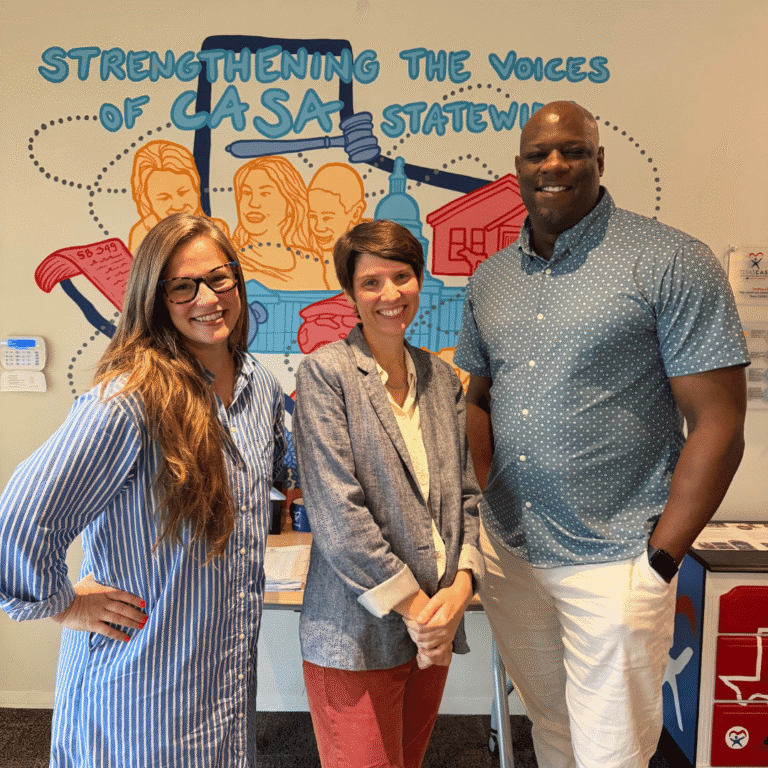
Over the last month and a half, I’ve had the privilege of visiting CASA programs across Texas and hearing firsthand the stories of children whose lives have been changed by the presence of a CASA volunteer. Each visit left me inspired by the compassion and persistence of these teams and volunteers. Time and again, I saw how local CASA programs and their volunteers are stepping up to fill essential gaps in services. Here are a few moments and insights that stayed with me from our Tour of Texas conversations with local program leaders:
- With the continued transition to Community-Based Care in Texas comes the loss of decades of institutional knowledge. As people step into new roles, they are learning both the nuances of the system and the children they serve. CASA volunteers bring much-needed continuity to a child’s entire team by sharing critical background and knowledge that helps ensure each child’s needs and best interests remain front and center.
- Local program impact story: In the first four months of 2026, 54 CASA volunteers traveled more than 20,000 miles to ensure children remained connected, cases stayed informed, and the decisions made reflected each child’s best interests.
- Across multiple programs, we saw that when children and families are unable to reach their caseworkers, especially after hours, CASA is often the one they call.
During my stop in Houston, I was honored to be interviewed by Mel Camp from KPRC Houston Life alongside Montgomery County CASA volunteer Amanda Crepin. Amanda explained how she had been a teacher for 25 years, and during her time in the classroom, she saw first-hand how children who have experienced a traumatizing event need a stable, consistent adult advocate by their side. She also revealed that if a teenager in foster care didn’t have a CASA volunteer, they would appear alone in court and without anyone to help prep them for a highly stressful event.
Stories like this show us that when systems are strained, children are the ones who feel the impact. Placement instability, delayed services, or unmet educational and mental health needs weigh heavily on a child who is already experiencing a crisis. That is why the role of a CASA volunteer is crucial. CASA volunteers are a steady presence who help ensure a child’s voice doesn’t get lost in the system. As we kick off National Foster Care Month this week, join our efforts in providing vital support to the CASA network as they bridge the gaps in a changing child welfare system. Donate today and make our statewide work possible.
Warmly,

Vicki Spriggs, Texas CASA CEO


 Read in English
  Leer en Español